
Key Considerations for a Nationwide Deployment
We have been building compliance recording systems and TS monitoring systems at individual broadcast stations for many years. However, when integrating at a scale of approximately 100 stations nationwide, a variety of new challenges arise that differ from conventional deployments.
For example, the following challenges can be identified:
- Visibility and operability issues regarding how users access each station
- How to consolidate and display alarms generated from multiple devices
- Bandwidth challenges related to smooth network-based access
- Cases requiring travel time to stations, and handling unmanned stations after evening hours
- Preparedness for the possibility of system outages during large-scale disasters
- Optimization of deployment costs
- Building a maintenance support system for nationwide scale
Addressing each of these challenges one by one, we worked toward the optimal system architecture.
※ Compliance Recording: A system that retains broadcast content aired by the station for at least three months, as required by the Broadcasting Act.
※ Monitoring: A system that monitors whether broadcast signals comply with standards such as ARIB.
Improved Visibility and Operability through an Integrated Aggregation System
While it is possible to have users access systems at each station individually via IP addresses or browser bookmarks, this is not practical at a nationwide scale when considering convenience and operability.
There was also the issue that in the event of failures or errors, users had to access each system individually to check its status.
We therefore introduced a top-level integrated aggregation system, enabling users to easily access each station from a single unified interface. This also allows errors and faults from each station’s monitoring system to be checked centrally through the integrated aggregation monitoring system.
The user interface underwent multiple design revisions, with a focus on intuitive operation. We aimed for operability at a level where users would feel they don’t need a manual, and refined the design down to the smallest details.
Additionally, to handle cases where multiple SNMP Traps occur simultaneously, we implemented a polling-based configuration in the integrated aggregation monitoring system to retrieve and display error information. This ensures that no alarms are missed even when multiple alerts occur at the same time.
Smooth Playback Environment via Network
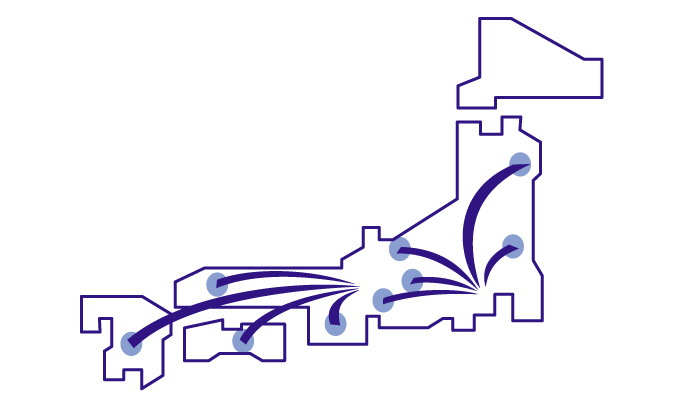
While the monitoring system itself does not require significant bandwidth, the compliance recording system generates approximately 20 Mbps of bitrate per channel.
Considering the possibility of simultaneous playback across approximately 100 stations nationwide, this would require substantial network bandwidth and become a factor in increased infrastructure costs.
To address this, Traffic Sim developed a mechanism to transcode full TS streams and convert them to low-bitrate TS of approximately 2 Mbps. This enables smooth playback even over a network connection.
The system also supports viewing of data broadcasting. The only differences from full TS are “video compression” and “no modulation.” This provides a sufficiently practical environment for standard operations.
System Configuration with BCP in Mind
To maintain system access and monitoring capabilities as much as possible even during large-scale disasters, we adopted a configuration with integrated aggregation monitoring systems installed in both eastern and western Japan.
Even if a disaster occurs at an eastern station and access to the eastern system becomes unavailable, compliance recording references and monitoring result verification can continue via the western system.
Anticipating numerous unmanned stations and overnight unmanned operations, we also equipped the system with a spare function that performs automatic rebuild in the event of an HDD failure. This maintains server redundancy even when a failure occurs, reducing the risk of data loss.
Furthermore, by using shared servers in 1-input and 2-input configurations, deployment costs have been reduced. We designed the system with a focus on ease of operation and cost balance.
Maintenance Support Structure
Not limited to nationwide-scale systems, we maintain a comprehensive maintenance support structure to ensure customers can use our services with confidence.
By signing a maintenance contract, customers can access the following services:
- Remote access unit (communication from standalone environments using 3G network)
- Inquiry support via phone and email
- TS data (capture data, etc.) analysis service
- Root cause investigation and correction for software malfunctions
- Root cause investigation and repair support for hardware malfunctions
- Free provision of replacement unit in case of hardware failure
- Fault isolation support with connected systems
- Hardware repair and replacement support
- Preferential replacement proposals when updating the system
※ Maintenance contract terms can be customized to match the customer’s environment.
We also conduct ongoing training and organizational development so that all staff members are capable of providing support.