
Challenges Before Implementation
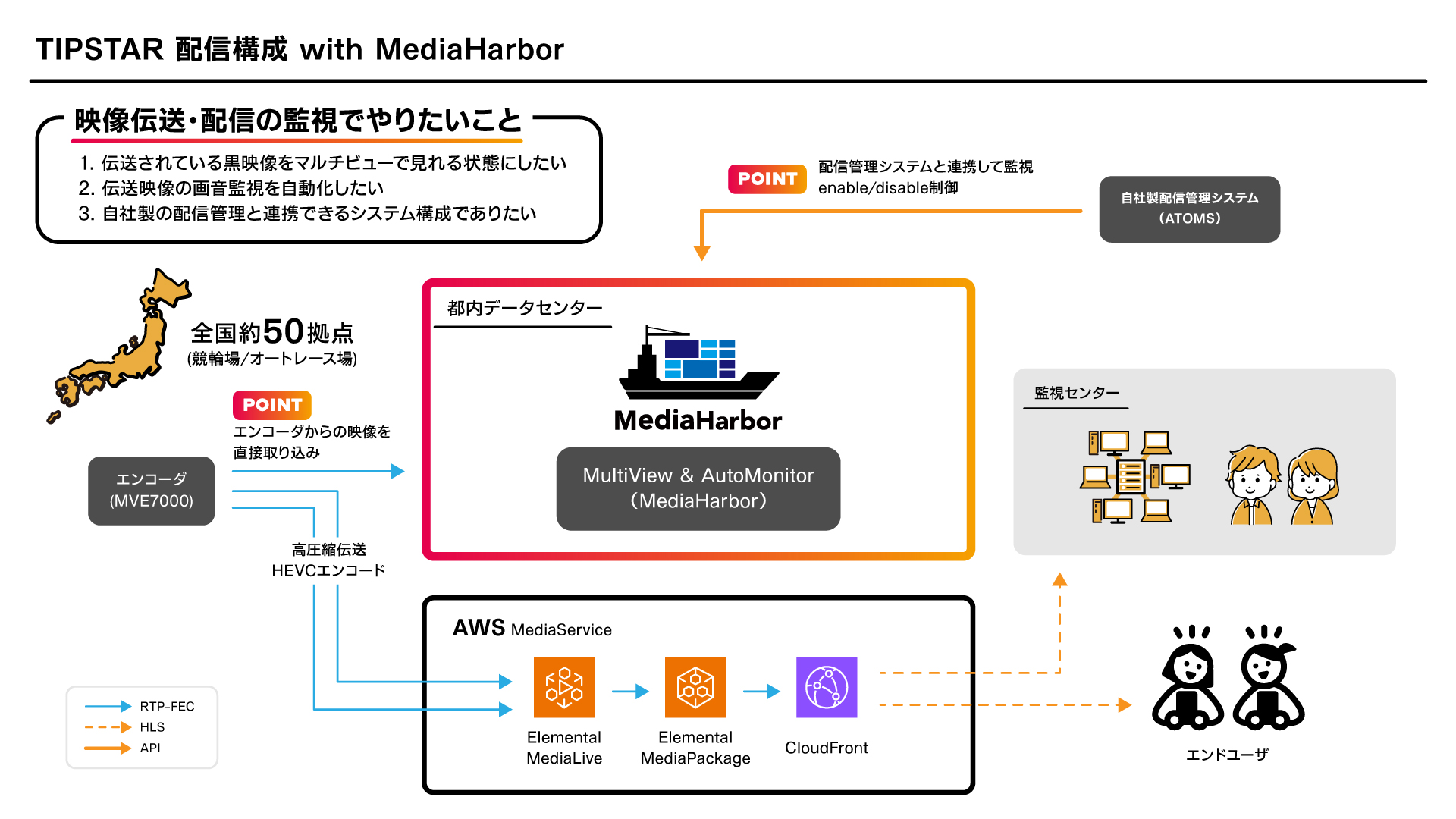
For the co-play sports betting service “TIPSTAR,” we were exploring solutions for multi-view monitoring and monitoring automation.
TIPSTAR has built its own nationwide network to simultaneously transmit video and audio from keirin (bicycle racing) and auto racing tracks across Japan to Tokyo. As a result, we needed to constantly monitor transmission status and signal integrity.
Before implementing MediaHarbor, we connected multiple coaxial inputs to multi-view monitors, converted them to IP streams, and then had staff manually monitor video and audio.
The following operational challenges had been identified:
- No flexibility in changing input sources or screen layouts, requiring physical on-site work
- Wanted to automate video/audio availability monitoring
- Difficult to integrate with other systems via API or automate operations
We had also considered overseas products, but they presented challenges in terms of cost-effectiveness and operational usability, and we had not proceeded to full-scale adoption.
Reasons for Selection
Q. What steps did you take during the implementation process? Was there anything that left a particularly strong impression?
During pre-implementation verification, you provided us with a trial license, and we conducted initial evaluation. When we shared our feedback and feature requests, an improved or beta version was presented to us the very next day — we were truly impressed by the development speed and flexibility.
For our company, which places a high value on speed, we felt we had found an excellent business partner.
Adoption Process
Q. With other options available, why did you choose our service?
We chose MediaHarbor not only because it could solve the challenges we faced, but also because we believed it would lead to cost reduction and lower operational burden.
The key points were as follows:
- High flexibility with multi-view creation via IP streams
- As a software solution, existing surplus assets can be effectively utilized
- Easy scaling based on the number of monitoring targets
- Flexible deployment model supporting both cloud and on-premises
MediaHarbor is not an appliance product but a service available in both cloud and on-premises environments, which aligned well with our company’s approach of operating our own data center.
In particular, by leveraging high-performance video processing servers that had become surplus assets, we were able to significantly reduce both cloud running costs and initial implementation costs.
Changes After Implementation
Q. What changes has implementing our service brought to your business or daily operations?
We can now not only display multi-view feeds from remotely transmitted video and encoder devices, but also perform audio/video monitoring.
Furthermore, by integrating with other monitoring systems, we feel it has contributed to improving the overall monitoring level of our service.
We have also been able to achieve low-cost implementation and operation, delivering high cost-effectiveness not found in competing products.
Specific Results
Q. What specific results or improvements have you seen since implementation?
Before MediaHarbor, we converted the output of a multi-view device receiving SDI signals to IP and used it as a viewing tool.
Configuration changes previously required on-site physical wiring work, but with MediaHarbor’s ability to accept various streaming inputs, flexible video and audio monitoring adapting to changes in business conditions is now possible.
Looking ahead, we also anticipate that simultaneous monitoring of frozen white/black frames — something previously unachievable — may now be realized at low cost.
Customer Voice
Q. Are there any aspects of our service you particularly like, or things you would like to see improved?
We highly value the provision of a playback player that supports audio verification for each stream — a capability that had been a challenge in simultaneous multi-stream monitoring.
We also find it very appealing that the API-based system design makes it easy to integrate with our in-house developed operational tools, Slack, and other external systems.
For the future, we hope to see further reduction of MediaHarbor’s processing load.
Our company primarily works with H.265 (HEVC), and we feel there is still room for improvement in the number of simultaneous processing streams. The current configuration is based on Intel CPU, and we believe that adding GPU support would further expand the choices when building MediaHarbor servers.
※ As of December 25, 2024
Words of Recommendation
Q. How would you recommend our service to other companies or colleagues in your industry?
The flexibility of Linux-based configuration and ease of implementation are its biggest attractions.
If you are looking for a multi-view and simple monitoring tool via IP streams, I think it is absolutely worth trying!
Architecture and System Configuration
Company
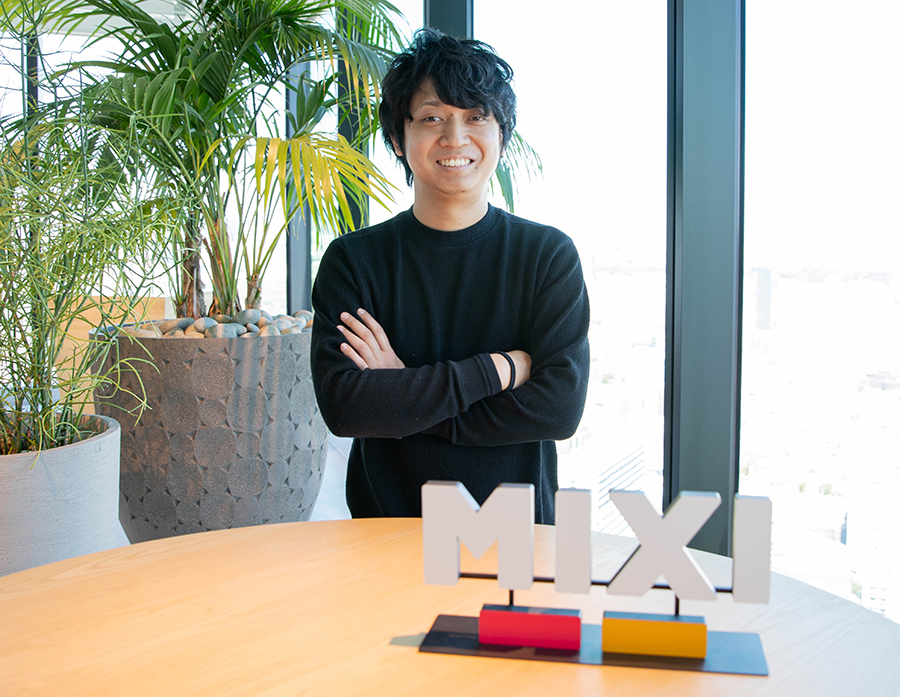
MIXI Inc.
Infrastructure Group, Tampopo Room, Development Division
Mr. Shinichi Ichino